
Compressed Air Dryer Selection Guide
Refrigerated or Desiccant: Which Air Dryer Does Your Application Need?
Choose the right compressed air dryer by pressure dew point, downstream temperature, airflow, inlet conditions, industry use and total operating risk.
Written by: Michael.Keng
Technical review: Engineer Wu
Topic: Compressed air dryer selection
Introduction
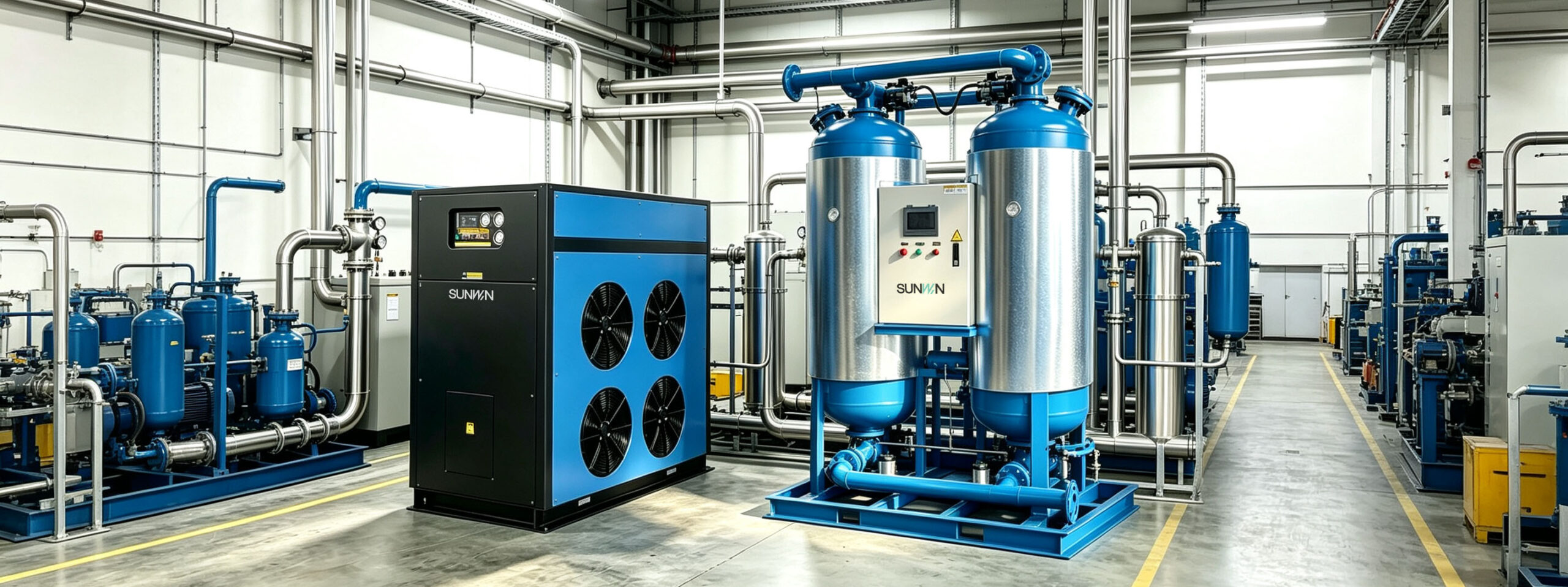
Choosing between a refrigerated air dryer and a desiccant air dryer is not a question of which technology is always better. It is a question of how dry the compressed air must be at the point of use, what temperatures the downstream piping and equipment will see, and how the dryer will perform under the real operating conditions of the plant.
A refrigerated air dryer is often suitable for general industrial compressed air systems where the required pressure dew point is within the dryer’s actual capability. A desiccant air dryer should be evaluated when the application requires a lower pressure dew point, or when downstream air lines may operate below the actual pressure dew point supplied by a refrigerated dryer.
The expensive mistake is choosing by nameplate flow or purchase price alone. This guide explains the practical decision framework for machinery workshops, paint lines, food packaging, laser cutting, outdoor instrument air and mining machinery service.
Quick Answer
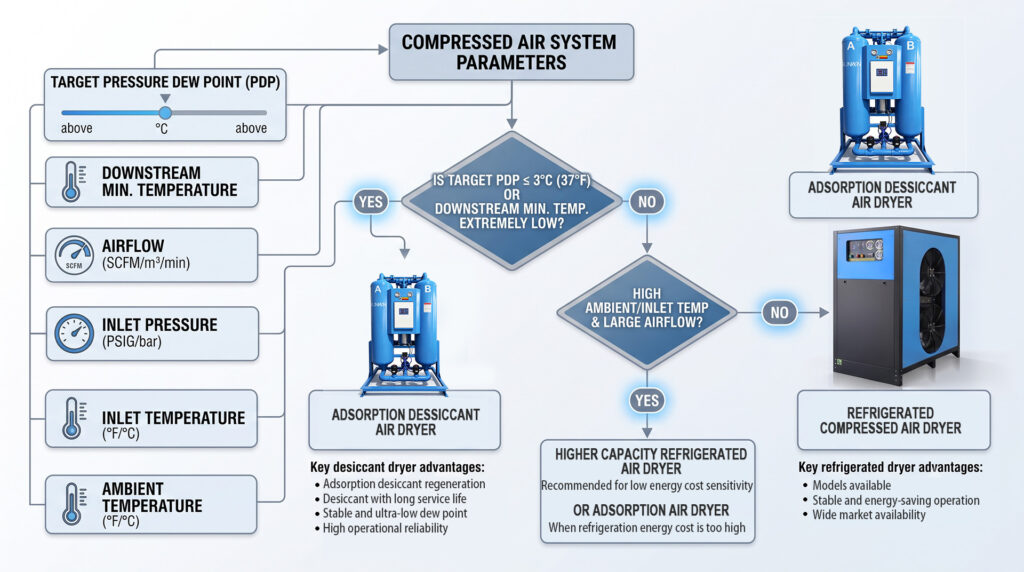
Choose a refrigerated air dryer when your required pressure dew point is within the dryer’s actual capability and the downstream air line stays warmer than that dew point. Choose or evaluate a desiccant air dryer when the required dew point is lower, the downstream piping may get colder, or the process cannot tolerate moisture.
For most general industrial compressed air systems, first check whether a refrigerated air dryer can meet the required pressure dew point at the actual site conditions. If it can, it is often the practical and economical choice.
- The required dew point is lower than a refrigerated dryer can reliably deliver.
- Downstream equipment may see temperatures below the refrigerated dryer’s actual pressure dew point.
- The process has low tolerance for moisture-related issues.
- The system requires a defined low dew point for protection or stability.
Question Summary
What is the main difference?
A refrigerated dryer removes moisture by cooling the air; a desiccant dryer is used when lower dew point performance is needed.
What is the main difference?
Often refrigerated, if the real pressure dew point requirement is within its actual capability.
Which is safer for cold outdoor piping?
Usually evaluate desiccant, because pipe temperature may fall below the dew point from a refrigerated unit.
What data is needed?
Target PDP, lowest downstream temperature, flow, inlet pressure, inlet temperature, ambient temperature and operating hours.
What Pressure Dew Point Means
Pressure dew point, often shortened to PDP, is the temperature at which water vapor in compressed air begins to condense at operating pressure. Compressed air must remain dry at the actual points where it is used, not only in the compressor room.
A compressor room may be warm while downstream piping passes through a cooler area. If the air reaches conditions where moisture can condense, liquid water may appear in piping, valves, pneumatic tools or production equipment.
Key selection question: What pressure dew point is required at the point of use under the lowest downstream temperature the system may experience? If the requirement is below 0 degrees C, or below the actual dew point a refrigerated dryer can provide on site, desiccant drying should be evaluated.
Where a Refrigerated Unit Usually Fits
Where a Desiccant Unit Usually Fits
A refrigerated air dryer cools compressed air so moisture condenses and can be separated and drained. It offers a practical balance of drying performance, operating simplicity and cost control when ultra-low dew points are not required.
- General factory air and typical pneumatic equipment.
- Downstream environments above the actual pressure dew point.
- Processes without a very low dew point requirement.
- Projects needing practical operation and cost control.
- Applications matching manufacturer data under real operating conditions.
Use a SUNWIN refrigerated air dryer as the product path for further evaluation. Final model selection still requires real airflow, inlet temperature, inlet pressure, ambient temperature and outlet dew point.
A desiccant air dryer removes moisture by adsorption. It uses desiccant material to achieve lower dew point performance, making it suitable for low-temperature exposure and moisture-sensitive processes.
- The required pressure dew point is below 0 degrees C.
- Downstream equipment may operate below a refrigerated dryer’s actual pressure dew point.
- Moisture carryover could interrupt production or damage equipment.
- The process requires a clearly defined low dew point.
- Site conditions exceed the practical range of refrigerated drying.
For these applications, a SUNWIN desiccant air dryer is the relevant product path. Check final selection against real site conditions and manufacturer data.
The Core Comparison
Selection Factor
Refrigerated Air Dryer
Desiccant Air Dryer
Typical role
General industrial drying within the dryer’s actual capability.
Lower-dew-point applications or systems with higher moisture sensitivity.
Main decision point
Can it meet target PDP under actual site conditions?
Is a lower PDP required than refrigerated drying can provide?
Downstream temperature
Suitable when downstream temperature remains above actual PDP.
Consider when downstream may be lower than refrigerated actual PDP.
Selection risk
Undersizing due to flow, inlet temperature, pressure or ambient conditions.
Over-specifying when low dew point is not actually needed.
Cost discussion
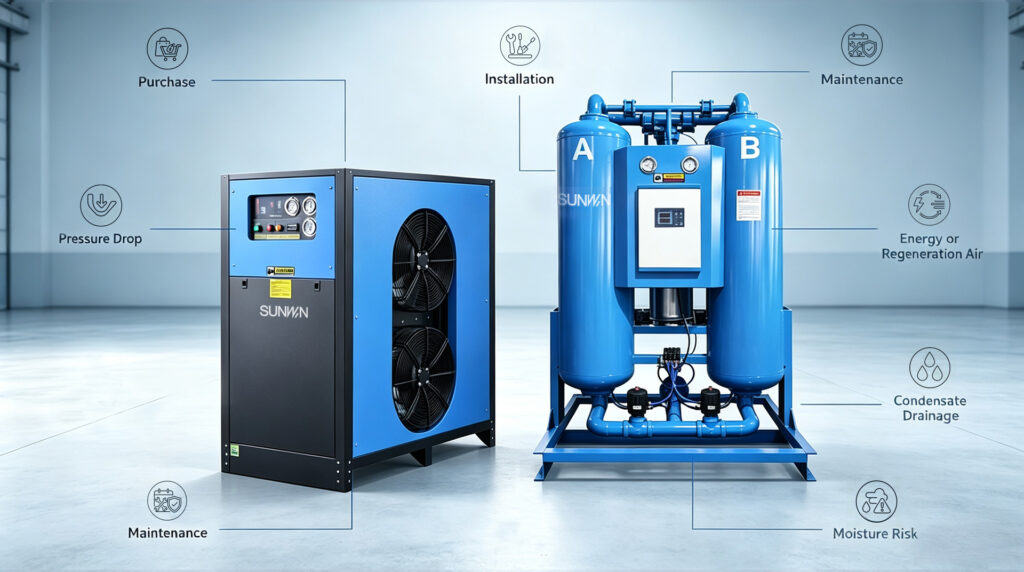
Purchase price, pressure drop, energy, maintenance and drains all matter.
Regeneration air or energy, filtration and maintenance must be considered.
The table is not a universal ranking. It is a boundary map: the right dryer meets the required air dryness under actual conditions without unnecessary cost or risk.
Why Nameplate CFM Is Not Enough
Dryer capacity changes with operating conditions. Higher flow increases water entering the dryer. Lower inlet pressure, higher inlet temperature and higher ambient temperature all change the moisture load or heat-rejection conditions. The required outlet dew point also affects selection.
- Maximum airflow
- Minimum inlet pressure
- Maximum inlet temperature
- Maximum ambient temperature
- Required outlet pressure dew point
- Minimum downstream temperature
- Operating schedule and load variation
Without these details, selection is only a rough guess.
The Lowest Purchase Price Problem
The lowest purchase price is not necessarily the lowest-cost solution. Compare the same target pressure dew point and the same site conditions, then consider equipment purchase, installation, pressure drop, energy or regeneration air, maintenance, filtration, condensate drainage and the risk of moisture-related production problems.
A refrigerated dryer may be economical when it meets the requirement. A desiccant dryer may be justified when the application truly needs lower dew point air or has higher moisture risk.
Industry Situations Buyers Actually Search For
Buyers often search from the problem in front of them: water in an air line, paint defects, laser lens contamination, frozen outdoor pipework or sticking pneumatic tools. These searches reveal the application behind the dryer choice.
Mining machinery compressed air
Check dust, high ambient temperature, long pipe runs and uneven air demand. A refrigerated unit may fit utility air, but outdoor or cold-region sites must check the lowest downstream temperature carefully.
Paint lines and powder coating
Moisture tolerance is much lower. Water reaching atomizing air can cause pinholes, bubbles, fisheyes or rework.
Food packaging compressed air
Base selection on the lowest pipe temperature and point-of-use air quality, not only compressor-room conditions.
Laser cutting air systems
For fiber laser cutting, the hidden cost of unstable dew point can exceed the visible dryer purchase price.
Field Examples from Real Selection Problems
These are anonymized field notes. Keep service records, photo records or customer approval on file before publishing exact percentages, loss amounts, photos or compliance language.
General Machinery Workshop: Flow Was Matched, Heat Load Was Not
A 15 m3/min compressor used a matching refrigerated unit. In summer, higher inlet and ambient temperatures reduced effective capacity. Pneumatic cylinders stuck and filters filled with water. The site upgraded to a higher-capacity high-temperature refrigerated dryer with proper pre-filtration.
Food Packaging Plant: Outdoor Pipework Was Colder Than the Dew Point
A standard refrigerated dryer supplied a long outdoor pipeline in a cold region. Frozen lines and instrument-air interruption showed that downstream pipe temperature was below delivered dew point. The solution used lower-dew-point desiccant drying plus pipe insulation.
Fiber Laser Cutting Shop: Low Purchase Price Became Process Risk
A small low-priced dryer package offered little margin in hot, humid weather. The retrofit used a high-temperature refrigerated dryer with final precision filtration; higher-power users can also consider desiccant backup where moisture risk is unacceptable.
Chemical Instrument Air: The Desiccant Dew Point Was Still Not Low Enough
Outdoor branches faced temperatures lower than the selected desiccant dryer’s rated dew point. The upgrade required a deeper-dew-point system plus insulation or heat tracing.
Paint Shop: Refrigerated Drying Was Wrong for the Process
Rapid local cooling in atomizing air created bubbles and pinholes. The process required lower dew point air and multi-stage oil removal filtration.
What Information Should You Prepare Before Asking for a Recommendation?
- Target pressure dew point
- Lowest downstream temperature
- Maximum and minimum airflow
- Inlet pressure and inlet temperature
- Ambient temperature around the dryer
- Application or process use
- Existing aftercooler, filters and drains
- Annual operating hours or operating schedule
With this information, a supplier can identify whether refrigerated drying is likely suitable, whether desiccant drying should be evaluated, and which data must be verified before final selection. For a project discussion, contact SUNWIN.
Common Mistakes to Avoid
- Choosing only by compressor horsepower.
- Using compressor-room temperature instead of lowest downstream temperature.
- Comparing dryer types without defining required pressure dew point.
- Treating purchase price as the whole cost.
- Requesting a final model without real site data.
Frequently Asked Questions
Which air dryer is better: refrigerated or desiccant?
Neither type is universally better. Refrigerated air dryers are practical for general industrial moisture removal, while desiccant air dryers are more suitable when a lower dew point or stronger protection against moisture is required.
Can a refrigerated air dryer be used in cold environments?
It depends on the required pressure dew point and the actual ambient conditions. If downstream piping may be exposed to temperatures that can cause residual moisture to condense or freeze, a desiccant air dryer may be the more appropriate solution.
What information is needed to select an air dryer?
Provide compressed air flow, working pressure, inlet temperature, ambient temperature, required dew point, voltage, application, and any air quality or filtration requirements.
Conclusion
The best way to choose between a refrigerated and desiccant air dryer is to define the real moisture requirement first. Start with target pressure dew point, lowest downstream temperature and actual operating conditions.
If the requirement is within the refrigerated dryer’s actual capability, refrigerated drying may be practical. If the system needs a lower pressure dew point or downstream conditions create condensation risk, desiccant drying should be evaluated.
Need Help Selecting the Right Air Dryer?
Send us your air flow, pressure, inlet temperature, ambient temperature, and dew point requirement. SUNWIN will help recommend a suitable refrigerated air dryer for your compressed air system.