
Blower Air Cooling System
Blower Air Cooling for Wastewater Treatment: How to Control Low-Pressure Discharge Temperature
Learn how to review low-pressure blower air cooling for wastewater treatment, including discharge temperature, airflow, pressure drop, materials and custom project data.
Written by: Michael.Keng
Technical review: Engineer Wu
Topic: Blower Air Cooling System
Quick Answer
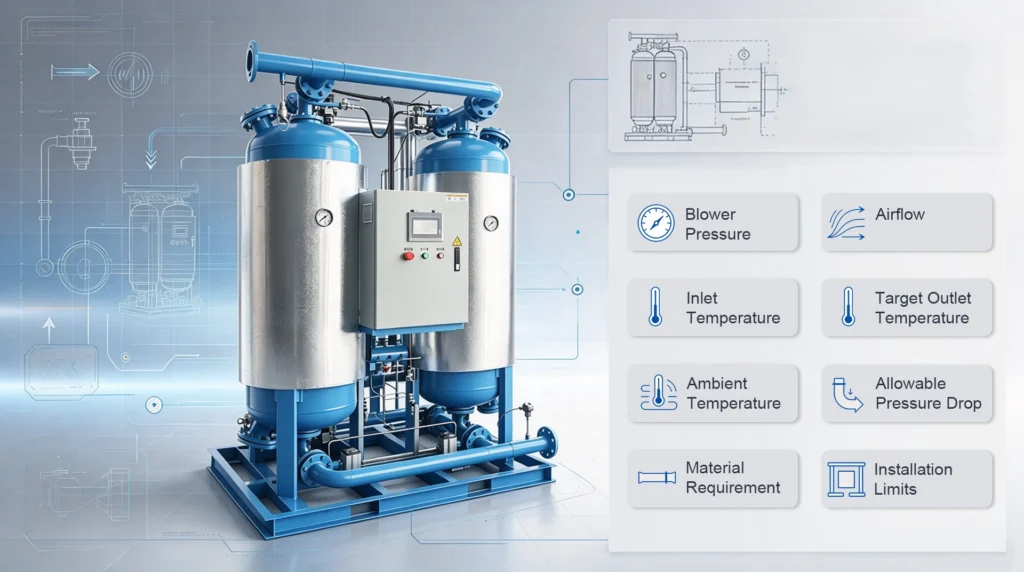
A blower air cooling system for wastewater treatment must be sized by blower pressure, airflow, inlet temperature, target outlet temperature, ambient condition and allowable pressure drop. Low-pressure blower air cannot be treated like ordinary 7–10 bar compressed air, because even a small pressure loss may affect the aeration system.
For distributors, EPC contractors and wastewater retrofit buyers, the safest first step is not to ask for a standard model. It is to send the operating data and let the supplier check whether a custom low-pressure blower air cooling system is technically suitable.
This Is Not A Standard Compressed Air Dryer Application
In a factory compressed air system, a buyer may ask for a refrigerated air dryer, desiccant air dryer or compressed air filter. Those products usually work with higher-pressure compressed air lines.
Wastewater blower air is different. Many aeration systems use low-pressure, large-flow air. The engineering problem is not only moisture removal. It may include hot blower discharge air, process temperature requirements, pressure drop limits, material selection and site installation constraints.
That is why a low-pressure blower air cooling project should not be quoted like a standard dryer. The question is not only “what capacity do you need?” The better question is:
What temperature must the blower air reach without creating too much resistance for the low-pressure system?
Why Wastewater Treatment Projects Care About Blower Air Conditions
Wastewater aeration systems depend on steady air delivery. Blowers, piping, diffusers and control conditions all work together as a system. If one part is changed without checking the rest, the result may be unstable flow, higher load on the blower or a project that is difficult to commission.
Hot discharge air can become a practical issue when the process, downstream equipment or project specification needs cooler air. In this case, the cooling system must be reviewed as part of the air delivery system, not as an isolated accessory.
For a municipal wastewater retrofit project, the buyer may care about specification compliance, installation risk and long-term maintainability. For an EPC contractor, the concern may be package integration and site schedule. For a compressed air or blower distributor, the main challenge may be turning the end user’s process requirement into clear technical data for the factory.
All three readers need the same thing: a reliable engineering review before selecting equipment.
The Main Risk: Pressure Drop In A Low-Pressure System
Pressure drop matters in every compressed air system, but it becomes especially sensitive in low-pressure blower applications.
In a 7 bar compressed air line, a small pressure loss may be annoying but not always critical. In a 0.5 bar blower system, the same pressure loss can become a much larger share of the available pressure. That is why a heat exchanger, cooling coil, piping layout or filter cannot be added casually.
Before selecting a blower aftercooler or custom cooling system, confirm:
- blower discharge pressure;
- normal and maximum airflow;
- allowable pressure drop;
- existing pipe size and route;
- downstream equipment or process requirement;
- whether the blower has enough margin for added resistance.
If the allowable pressure drop is unknown, the cooling system design is not ready for final quotation.
Key Data Needed Before A Custom Recommendation
Required Data
Why It Matters
Blower pressure
Defines the low-pressure boundary and pressure drop sensitivity
Airflow
Determines heat load, exchanger size and package layout
Inlet air temperature
Shows how much cooling is required
Target outlet temperature
Defines the cooling target, but should not be promised without design review
Ambient temperature
Affects heat rejection and site operating condition
Allowable pressure drop
Protects blower flow and system stability
Air humidity and condensate condition
Helps judge drainage and material needs
Material requirement
May affect stainless steel, coating or corrosion protection decisions
Installation limits
Controls module size, access, lifting, piping and export packing
Electrical data
Helps confirm voltage, phase, frequency and local compatibility
These inputs are more useful than a generic product name such as “pre-cooler” or “low-pressure air treatment system.”
Question Summary
Question
Short Answer
Can a standard refrigerated air dryer solve hot blower discharge air?
Not automatically. Low-pressure blower cooling is a different engineering problem and needs pressure drop review.
What is the most important sizing risk?
Allowable pressure drop, because the system operates at low pressure.
Can the outlet temperature be guaranteed from a keyword alone?
No. It depends on pressure, airflow, inlet temperature, ambient condition, cooling method and design margin.
Who should read this article?
Blower distributors, compressed air distributors, EPC contractors and wastewater retrofit technical buyers.
Anonymous Project Example: 0.5 Bar Blower Air Cooling
In one overseas wastewater treatment project, the end user needed a custom cooling solution for low-pressure blower air.
The working condition was approximately:
- blower pressure around 0.5 bar;
- airflow in the 16–22 m³/min range;
- inlet air temperature around 80°C;
- target outlet air temperature at or below 30°C;
- custom low-pressure design instead of a standard compressed air dryer;
- modular delivery to reduce overseas installation difficulty.
This case shows why the early technical conversation is important. The customer did not simply need a catalog model. The project had to consider low pressure, high inlet temperature, large airflow, pressure loss, material options, export packing and local assembly conditions.
The result from this project should not be treated as a universal performance promise. A different site may require a different heat exchanger, cooling capacity, material, structure or control design.
What A Distributor Should Ask Before Quoting
Compressed air and blower distributors often receive project opportunities before all technical details are clear. The end user may say, “We need to cool blower air,” but the factory cannot design a reliable system from that sentence alone.
A distributor should collect:
- blower model and performance data;
- pressure at the cooling system inlet;
- airflow range, not only one nominal point;
- inlet temperature during worst normal operation;
- required outlet temperature and why it is required;
- allowable pressure drop;
- operating hours;
- site ambient temperature;
- available cooling method and utility conditions;
- space, access and module size restrictions;
- material preference, such as carbon steel, stainless steel or corrosion-resistant parts;
- export packing and local installation requirements.
This turns a vague inquiry into a real engineering discussion. It also protects the distributor from underquoting a project that later becomes expensive or difficult to install.
What An EPC Or Municipal Retrofit Buyer Should Check
For EPC contractors and municipal wastewater retrofit teams, the decision is not only equipment price. The practical questions are:
- Will the cooling system fit the existing blower room or outdoor layout?
- Can it be installed without excessive piping changes?
- Is the pressure drop acceptable for the existing blower?
- Are drawings available for coordination?
- Can the package be split into modules for transport or site assembly?
- Are material and corrosion requirements clearly defined?
- What data must be checked before performance expectations are written into a specification?
These checks help define a controlled engineering package for air-temperature management without treating it as a shortcut to guaranteed wastewater-treatment performance.
When A Custom System Makes More Sense Than A Catalog Product
A custom low-pressure blower air cooling system may be worth reviewing when:
- the blower discharge temperature is too high for the process requirement;
- the system operates at low pressure and cannot tolerate uncontrolled pressure loss;
- the airflow is large and outside ordinary compressed air dryer selection habits;
- the project needs stainless steel or special material options;
- the equipment must be exported in modules;
- the local team needs drawings, installation guidance or package coordination;
- the buyer is not sure whether a standard dryer, aftercooler or heat exchanger is suitable.
The word “custom” does not mean every project becomes complicated. It means the supplier should not pretend that one standard product fits all low-pressure blower systems.
Common Mistakes To Avoid
Do not size the system by airflow alone. Temperature difference, pressure, pressure drop and ambient condition matter.
Do not assume a standard refrigerated air dryer is suitable for blower discharge air. A dryer product page may show cooling and condensate removal, but low-pressure blower cooling needs a separate engineering check.
Do not ignore pressure drop. In low-pressure systems, pressure loss can become the hidden failure point.
Do not write guaranteed outlet temperature into a specification before the supplier reviews the operating data.
How This Relates To Refrigerated Dryers And Filters
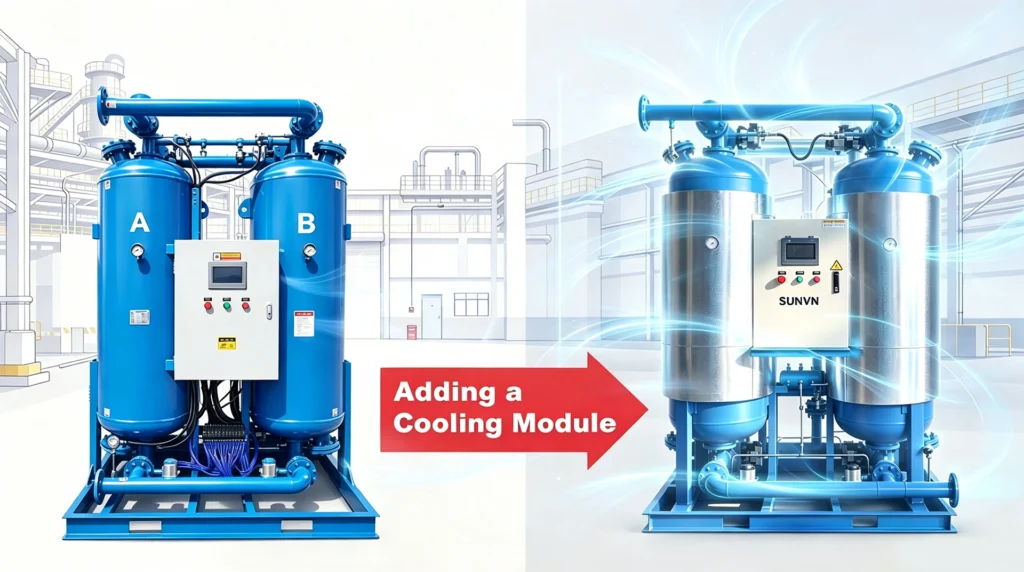
SUNWIN’s standard refrigerated air dryers and compressed air filters are designed for conventional compressed-air treatment. Low-pressure blower air cooling is a separate, project-specific application.
For low-pressure blower air cooling, the engineering discussion starts earlier. The supplier must first understand the blower system and the cooling target. Only after that can the project team decide whether the solution should use a cooling package, heat exchanger structure, filtration, drainage, stainless steel options or other supporting components.
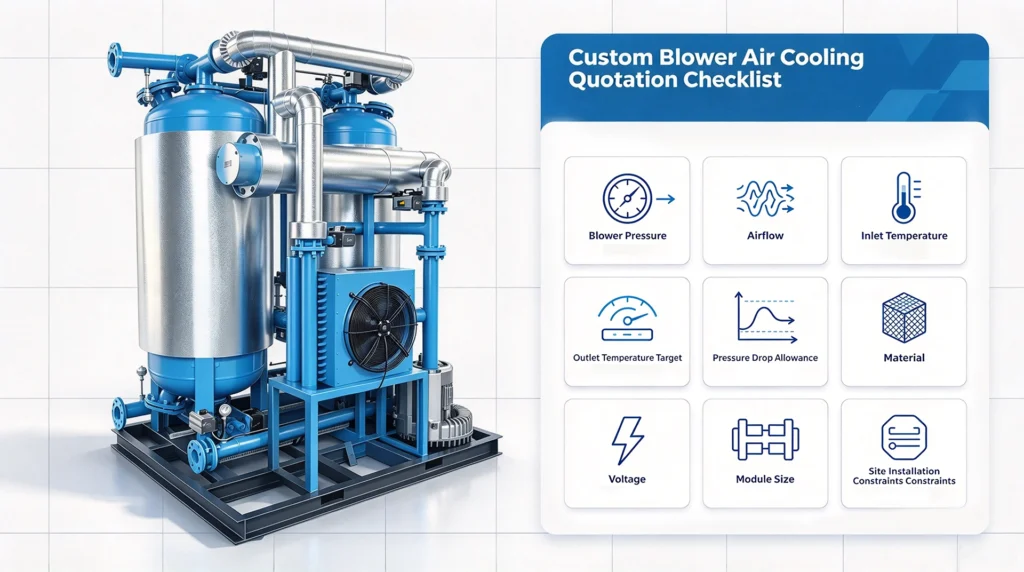
What To Send For Engineering Review
Send:
- blower pressure;
- airflow range;
- inlet air temperature;
- target outlet air temperature;
- ambient temperature;
- allowable pressure drop;
- air humidity or condensate concern;
- material requirement;
- available voltage, phase and frequency;
- installation space and pipe layout;
- whether the system must be exported as modules;
- photos, drawings or a simple process sketch if available.
With this information, a supplier can review whether a custom low-pressure blower air cooling system is technically suitable for the wastewater treatment project.
Frequently Asked Questions
What is blower air cooling in wastewater treatment?
It is the process of reducing hot blower discharge air temperature before the air reaches the downstream system or process. In wastewater treatment, this must be reviewed together with blower pressure, airflow and pressure drop.
Is blower air cooling the same as a refrigerated air dryer?
No. A refrigerated air dryer is normally selected for compressed air moisture control. Low-pressure blower air cooling is a custom temperature-control and system-integration problem.
Why is pressure drop so important?
Low-pressure blower systems have limited available pressure. Added resistance from a cooler, exchanger or piping change can affect airflow and system operation if it is not checked.
Can you cool 80°C blower air to 30°C?
It may be technically possible under specific conditions, but the target temperature alone is not enough to confirm performance. The supplier must review pressure, airflow, ambient condition, allowable pressure drop and cooling design.
What should a distributor send before asking for a quotation?
Send blower pressure, airflow, inlet temperature, target outlet temperature, ambient temperature, allowable pressure drop, material requirements, electrical data and installation limits.
Conclusion
Blower air cooling for wastewater treatment is a system engineering task, not a simple catalog selection. The key checks are low-pressure operation, airflow, inlet and outlet temperature, ambient condition, allowable pressure drop, material requirements and installation limits.
Send your blower pressure, airflow, inlet temperature, target outlet temperature, ambient condition, allowable pressure drop, material requirement and installation limits. We can review whether a custom low-pressure blower air cooling system is technically suitable for your wastewater treatment project.
Need Help Selecting the Right Air Dryer?
Send us your air flow, pressure, inlet temperature, ambient temperature, and dew point requirement. SUNWIN will help recommend a suitable refrigerated air dryer for your compressed air system.