
Desiccant Air Dryer Selection Guide
Desiccant Air Dryer Selection Guide: Dew Point, Purge Air and Regeneration Types
Meta description: Choose a desiccant air dryer by pressure dew point, purge air, regeneration type, flow rate, pressure, temperature and filtration protection.
Written by: Michael.Keng
Technical review: Engineer Wu
Topic: Compressed air dryer selection
Quick Answer
Featured snippet answer:
Choose a desiccant air dryer when the application needs a pressure dew point below 0°C, when downstream piping may operate in low temperatures, or when moisture-sensitive equipment cannot tolerate condensation. Then compare regeneration type, purge air, flow rate, pressure, inlet temperature, filtration protection and operating hours.
A desiccant dryer is not automatically better than a refrigerated dryer. It should be selected when the required dew point and site conditions justify the lower moisture level and the operating cost.
When A Desiccant Dryer Makes Sense
A desiccant air dryer is used when compressed air must be drier than a refrigerated dryer can normally provide under actual site conditions. Typical reasons include low downstream temperature, outdoor piping, instrument air, moisture-sensitive production equipment, painting, packaging or applications where condensation creates unacceptable risk.
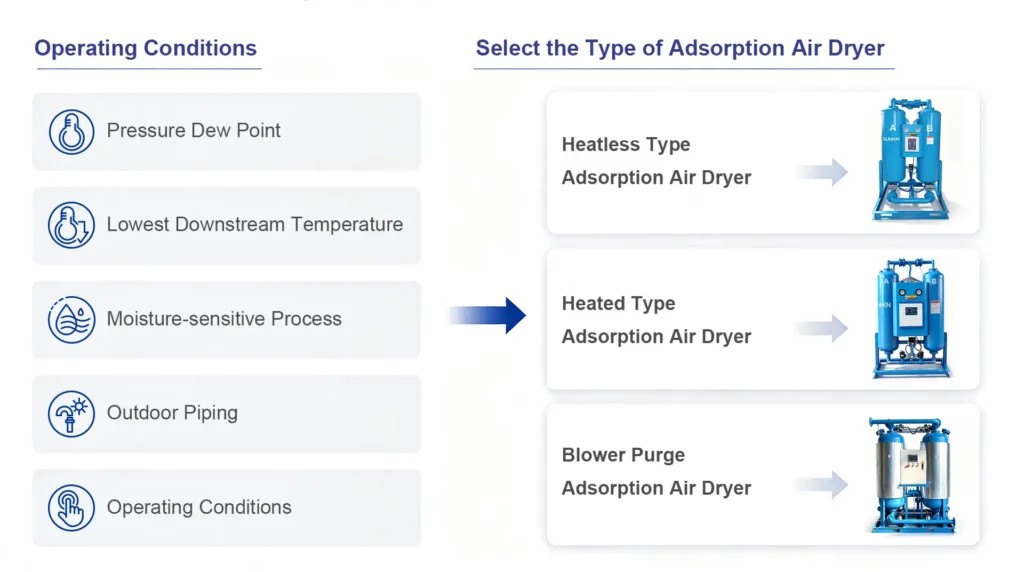
If your target pressure dew point is within the actual capability of a refrigerated dryer, a desiccant dryer should not be recommended by default. The first question is always the required pressure dew point at the point of use.
The decision should consider:
- required pressure dew point;
- lowest downstream pipe or ambient temperature;
- moisture sensitivity of the process;
- actual flow rate;
- working pressure;
- inlet temperature;
- oil, water and particle contamination;
- operating hours;
- purge air and energy cost.
Pressure Dew Point Comes First
Pressure dew point is the temperature at which water vapor in compressed air begins to condense at operating pressure. For dryer selection, it is not enough to know the compressor room temperature. You need to know the lowest temperature the air may experience downstream.
If the air line passes through an outdoor pipe rack, a cold workshop, an instrument cabinet or a low-temperature production area, the point-of-use risk may be very different from the dryer room.
A desiccant dryer should be evaluated when the system needs a lower pressure dew point or when the downstream temperature may fall below what a refrigerated dryer can reliably provide.
Do not publish a fixed dew point claim unless it is supported by a specific model data sheet and actual operating conditions.
Regeneration Types: Heatless, Heated Purge And Blower Purge
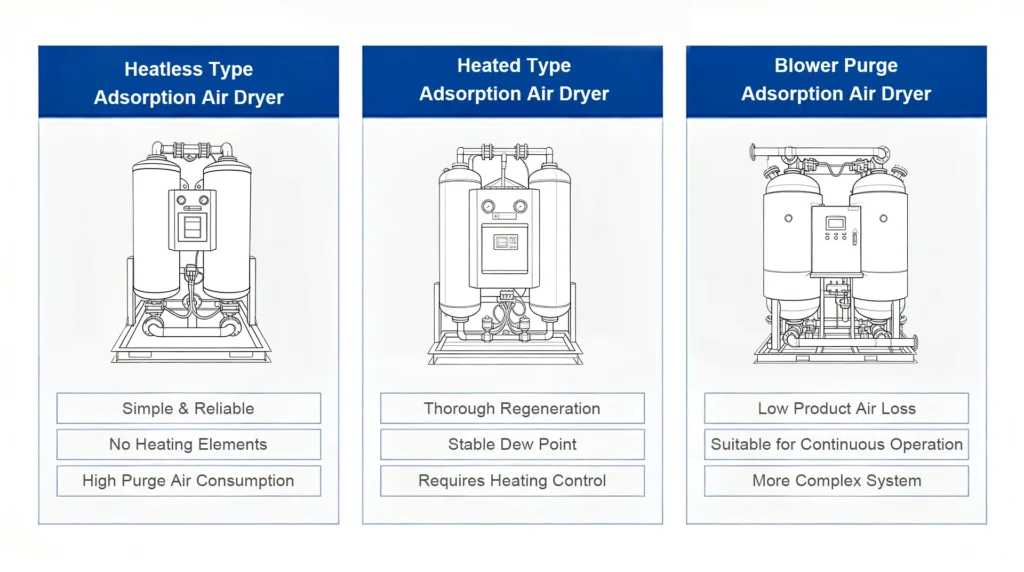
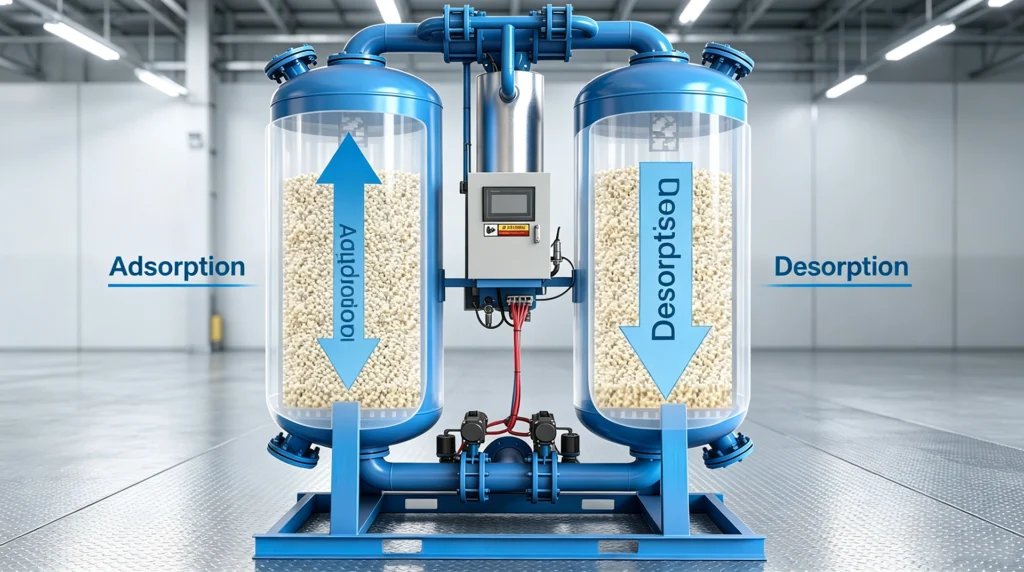
Desiccant dryers remove moisture by adsorption. The desiccant must then be regenerated so it can keep adsorbing moisture. The regeneration method is one of the biggest differences between dryer types.
Regeneration Type
Basic Idea
Selection Consideration
Heatless
Uses a portion of already dried compressed air as purge air
Simple structure, but purge air becomes an operating cost
Heated purge
Uses heat to reduce the amount of purge air needed
May reduce compressed air loss, but adds heater and control complexity
Blower purge
Uses external blower air and heat for regeneration
May reduce or avoid compressed air purge, but equipment is more complex
These are directional differences. Do not assume a fixed purge percentage for every brand or model. Actual purge rate, power consumption and pressure drop must come from the selected product data.
Purge Air Is A Real Operating Cost
Purchase price is only one part of the decision. Purge air, pressure drop, electrical power and operating hours can change the total cost of ownership.
Heatless dryers may have a simpler design, but the purge air is compressed air that has already consumed compressor energy. Heated purge and blower purge systems may reduce compressed air loss, but they add heaters, blowers, controls and maintenance considerations.
The right comparison uses:
- required pressure dew point;
- actual flow rate;
- working pressure;
- operating hours;
- regeneration method;
- purge air or cooling air consumption;
- dryer power;
- pressure drop;
- local energy cost;
- maintenance requirements.
Without these inputs, claims such as “lowest cost” or “most energy saving” are not meaningful.
Flow, Pressure And Temperature Change Sizing
A desiccant dryer should be selected for the real site conditions.
Flow rate affects the amount of air and water vapor the dryer must handle. Minimum inlet pressure matters because dryer capacity and actual air velocity change with pressure. Higher inlet temperature increases moisture load and can require a larger dryer or upstream cooling.
The basic inputs for sizing include:
- maximum and normal flow rate;
- minimum working pressure;
- maximum inlet temperature;
- ambient temperature;
- required pressure dew point;
- operating schedule;
- downstream minimum temperature.
If a buyer only provides compressor power, the selection is not reliable. Compressor kW or HP is not a substitute for actual airflow and dryer inlet conditions.
Oil And Particles Can Damage The System
Desiccant dryers need protection from contamination. Oil, water and particles can affect desiccant performance and downstream air quality. In many systems, a coalescing pre-filter is evaluated before the desiccant dryer, and a particulate after-filter is evaluated after the dryer to capture desiccant dust.
The exact filtration arrangement depends on the compressor type, oil content, upstream water separation, target air quality and point-of-use requirement.
This is where compressed air filters and replacement filter elements become part of the dryer package, not an afterthought.
Industry Situations Buyers Search For
Instrument air and chemical plants often care about stable dry air because valves, actuators and control instruments can be sensitive to water, corrosion and freezing.
Outdoor piping and winter freezing are strong desiccant dryer signals. If the pipe temperature can fall below the delivered pressure dew point, condensation or ice may appear downstream.
Paint shops may need dry compressed air to reduce moisture-related coating defects. The final air quality still depends on filtration, oil control, spray equipment and process conditions.
Laser cutting and packaging applications can be moisture-sensitive, but the exact requirement must come from the equipment manufacturer, process condition and air quality target.
Food packaging can be discussed as a moisture-risk application, but the article should not claim food-grade compliance without validation.
Common Mistakes
Do not choose only by the lowest dew point printed in a brochure. The real question is whether the selected model can meet the required PDP under your flow, pressure and temperature conditions.
Do not ignore purge air. Regeneration air can become part of the long-term energy cost.
Do not skip pre-filter and after-filter review. Oil and particles can create performance and maintenance problems.
Do not compare heatless, heated purge and blower purge by purchase price alone. Compare operating hours, air loss, electrical power, pressure drop and maintenance.
Do not use food or pharmaceutical freeze-drying terms for industrial compressed air dryers.
What To Send For A Recommendation
Send:
- application or point of use;
- required pressure dew point;
- lowest downstream or outdoor temperature;
- maximum and minimum flow rate;
- working pressure;
- inlet temperature;
- ambient temperature;
- operating hours;
- compressor type and oil content concern;
- existing pre-filter and after-filter setup;
- whether the air is for instrument air, paint shop, laser cutting, food packaging, outdoor piping or another high-demand use.
With this information, a supplier can review the suitable desiccant dryer type, purge method and data that should be verified before quotation.
Frequently Asked Questions
When do I need a desiccant air dryer?
You should evaluate a desiccant air dryer when the required pressure dew point is below the practical range of refrigerated drying, when downstream piping may be colder than the delivered dew point, or when the process is moisture-sensitive.
Is heatless or heated purge better?
Neither is always better. Heatless dryers are simpler but use dry compressed air for regeneration. Heated purge dryers use heat to reduce purge air, but add heater and control complexity.
What is blower purge?
Blower purge uses external blower air, usually with heat, to regenerate the desiccant. It can reduce or avoid compressed air purge depending on the dryer design.
Why does purge air matter?
Purge air is compressed air that has already required compressor energy. It should be included in operating cost comparisons together with pressure drop, dryer power and operating hours.
Can a desiccant dryer alone define the final air quality class?
Do not assume that. Final compressed air quality depends on the full system, test point, dryer, filtration, oil control and operating conditions. A specific class claim needs product data and validation.
Conclusion
Desiccant air dryer selection starts with the required pressure dew point and the actual downstream temperature. After that, compare regeneration type, purge air, flow rate, working pressure, inlet temperature, filtration protection and operating hours.
Send your application, required PDP, flow rate, working pressure, inlet temperature, ambient temperature, operating hours, compressor type and existing pre/post filtration. We can help review the suitable desiccant dryer type, purge method and data that should be verified before quotation.
Need Help Selecting the Right Air Dryer?
Send us your air flow, pressure, inlet temperature, ambient temperature, and dew point requirement. SUNWIN will help recommend a suitable refrigerated air dryer for your compressed air system.