
Compressed Air Filter Element Replacement
How Often Should You Replace Compressed Air Filter Elements?
Meta description: Learn when to replace compressed air filter elements by pressure drop, operating hours, oil and water load, filter type, compatibility and downstream equipment risk.
Written by: Michael.Keng
Technical review: Engineer Wu
Topic: When To Replace Compressed Air Filter Elements
Quick Answer
Featured snippet answer:
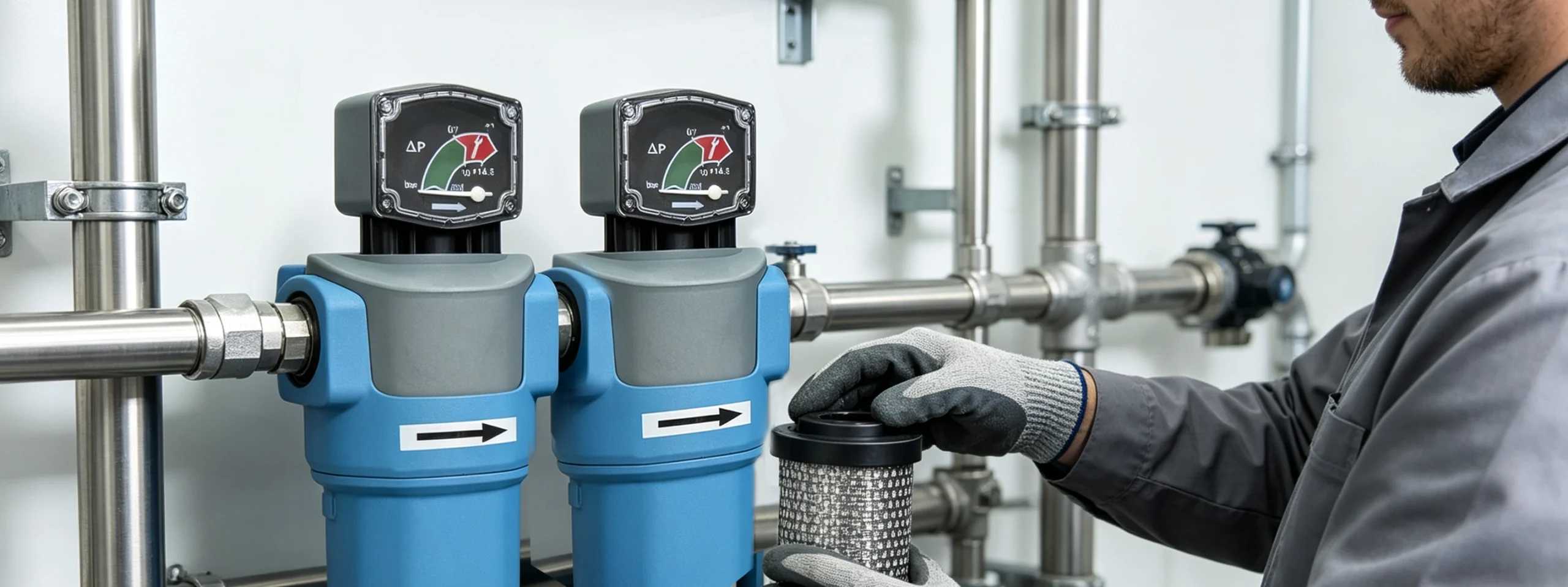
Replace compressed air filter elements based on differential pressure, operating hours, contaminant load, drainage condition, filter type, manufacturer guidance and downstream equipment risk. There is no single replacement interval that fits every compressed air system.
A filter element in a clean, lightly loaded system may last longer than one exposed to heavy oil mist, liquid water, dust, poor drainage or high flow. The right replacement decision should protect dryers, pneumatic tools, valves and production equipment without relying on a fixed calendar rule alone.
Why There Is No Universal Replacement Interval
Compressed air filter elements work under different conditions. Some filters handle dry particle load. Some remove liquid water mist and oil aerosol. Some use activated carbon or adsorption media for vapor and odor control. Each condition affects how quickly the element loads.
That is why a single rule such as “replace every six months” is not reliable for every plant. It may be too early for one system and too late for another.
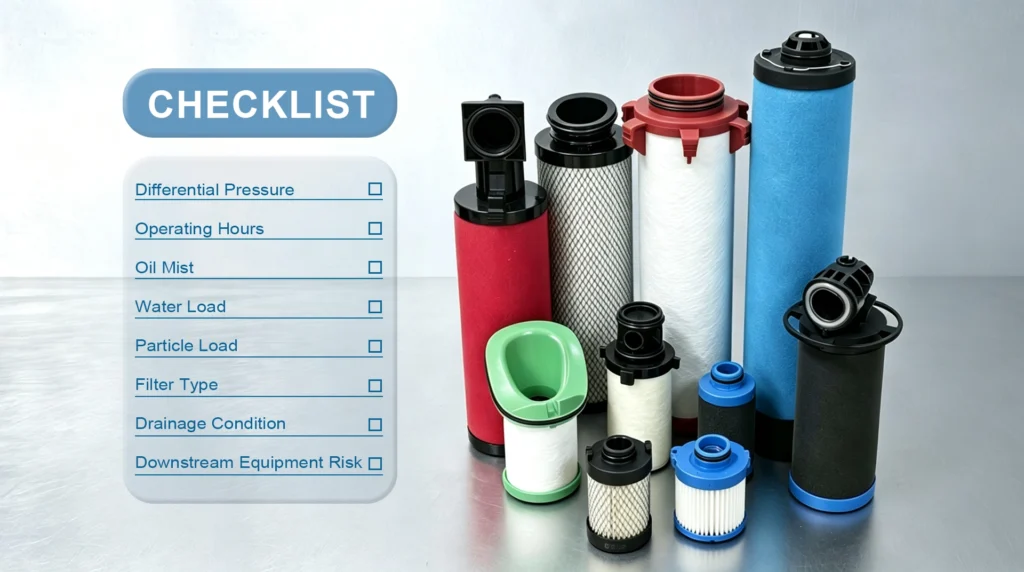
A better replacement plan uses:
- differential pressure or pressure drop trend;
- operating hours;
- contaminant load;
- filter type and grade;
- drainage condition;
- compressor type;
- downstream equipment risk;
- manufacturer recommendation;
- actual site maintenance history.
Question Summary
Question
Short Answer
Is there one replacement interval for every filter element?
No. The interval depends on pressure drop, operating hours, contaminant load, drainage, filter type and downstream risk.
What is the strongest warning sign?
A rising differential pressure is one of the most practical signs that the element should be inspected.
Can I choose a replacement by size only?
No. Check model, housing, filter grade, end cap, seal, flow, pressure and application.
What makes elements fail early?
Heavy oil mist, liquid water, dust, poor drainage, high flow or wrong installation can increase loading.
Pressure Drop Is A Key Warning Sign
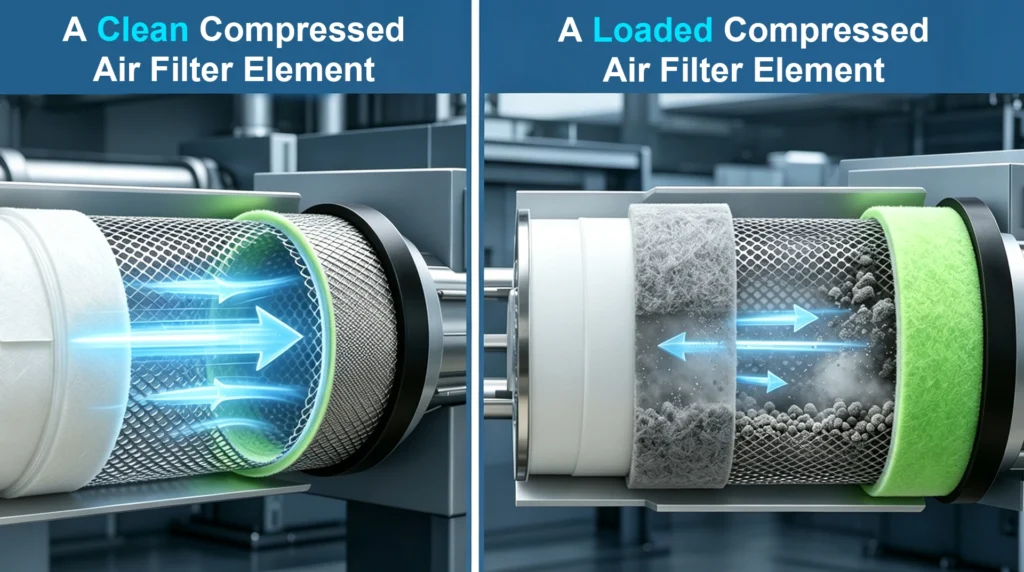
As a filter element loads with contamination, pressure drop can increase. Higher pressure drop may reduce usable system pressure and can affect operating cost because the compressor system must work harder to deliver air at the required point of use.
Pressure drop does not tell the whole story, but it is one of the most practical maintenance signals. A sudden or steadily rising differential pressure should trigger inspection.
Possible causes include:
- loaded filter element;
- undersized filter;
- flow higher than expected;
- heavy oil or water carryover;
- blocked drain;
- wrong element type;
- incorrect installation.
Do not publish a fixed pressure drop limit unless it comes from the specific filter manufacturer or the plant’s approved maintenance standard.
Oil, Water And Particle Load Change Element Life
Filter elements do not all see the same contamination load.
A coalescing element exposed to heavy oil mist or liquid water can load faster than expected. Poor condensate drainage can make the problem worse. A particulate element placed after a desiccant dryer may deal with dust from the desiccant bed. Activated carbon or adsorption elements need upstream protection from liquid oil, water and particles.
This is why replacement timing must be based on the real system, not only the calendar.
If a filter element fails early, check the cause before simply installing the same replacement:
- Is there excessive oil carryover?
- Is liquid water reaching the filter?
- Is the drain working?
- Is the filter installed in the right position?
- Is the upstream dryer or separator working?
- Is the flow higher than the housing rating?
Filter Type And Grade Matter
Different filter types have different jobs. A particulate element, coalescing element and activated carbon element should not be treated as interchangeable parts.
The filter grade also matters, but grade alone is not enough. A finer element may create higher pressure drop or load faster if it is installed without proper upstream protection. A lower-grade element may not protect sensitive downstream equipment.
Use the filter grade together with flow rate, working pressure, contaminant type, installation position and downstream equipment requirement.
If the application is paint spraying, laser cutting, food packaging, pneumatic tools or CNC machining, the risk of contamination should be reviewed at the point of use, not only at the compressor room.
Do Not Replace By Appearance Or Low Price Alone
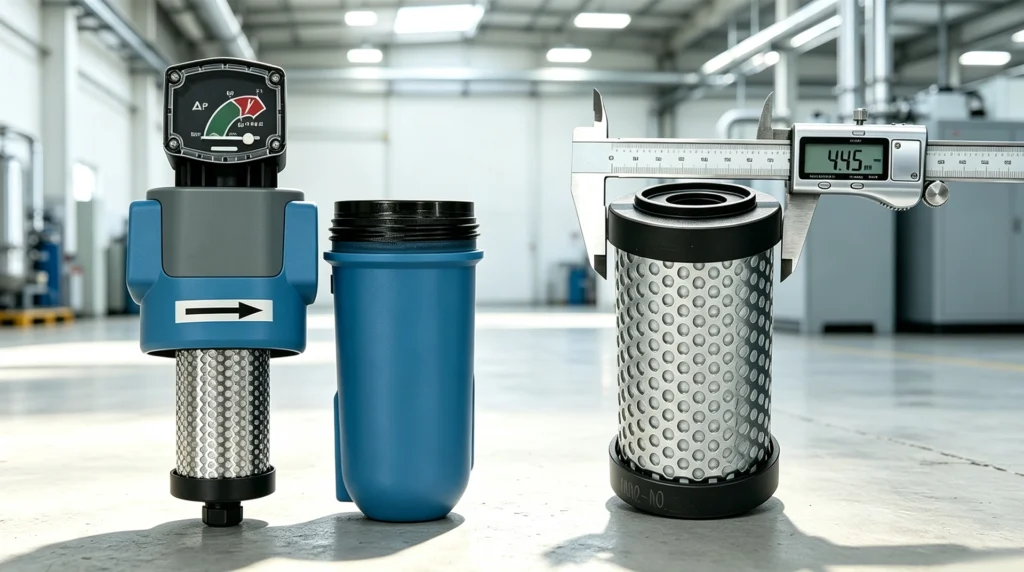
Replacement filter elements must fit the housing and the application. Similar appearance is not enough.
Before selecting a replacement element, confirm:
- original filter brand and model;
- filter housing model;
- element dimensions;
- end cap design;
- seal structure;
- filter grade;
- flow and pressure conditions;
- installation position;
- contaminant type;
- downstream equipment requirement.
A mismatched element may create sealing risk, pressure drop problems or uncertain filtration performance. This does not mean every compatible element is poor. It means compatibility must be checked with data, dimensions and application conditions.
How Filter Elements Protect The System
The cost of a filter element is usually small compared with the cost of wet air reaching production equipment.
A loaded or incorrect element may reduce protection for:
- refrigerated and desiccant dryers;
- pneumatic tools;
- valves and actuators;
- spray guns and paint lines;
- laser cutting air paths;
- food packaging valves and instruments;
- CNC fixtures and machining equipment.
The required replacement timing depends on how sensitive the downstream equipment is. A general workshop may tolerate more variation than a paint line or moisture-sensitive packaging process.
Common Field Patterns
In general machinery and CNC shops, filter elements are often replaced only after tools begin to stick or water appears at the air line. That is a reactive maintenance pattern. A pressure drop trend and regular inspection can catch the problem earlier.
In paint shops, a loaded or incorrect element can allow oil, water or particles to reach the spray process. The result may look like a coating problem, but the root cause can be compressed air treatment.
In laser cutting, moisture and particles can create quality and maintenance complaints around the cutting air path. Replacement timing should be more conservative when the downstream equipment is expensive or sensitive.
In food packaging and instrument air lines, the filter element is part of a broader contamination control strategy. Do not treat it as a cheap consumable only. Treat it as a documented maintenance item connected to air quality risk.
In systems with desiccant dryers, after-filters may capture desiccant dust while pre-filters protect the desiccant bed from oil and water. Both positions should be reviewed separately because they face different contamination loads.
What To Send For A Replacement Recommendation
Send:
- current filter element model;
- filter housing model;
- clear photos of the element and housing label;
- dimensions;
- end cap and seal structure;
- filter grade;
- application;
- flow rate;
- working pressure;
- inlet temperature;
- contamination concern;
- drainage condition;
- downstream equipment being protected.
With this information, a supplier can check suitable replacemen filter element options.
Frequently Asked Questions
How often should compressed air filter elements be replaced?
Replace them based on pressure drop, operating hours, contamination load, filter type, drainage condition, manufacturer guidance and downstream equipment risk. There is no universal interval for every system.
Is pressure drop a sign that the filter element needs replacement?
Yes, rising pressure drop can be a warning sign. It may indicate a loaded element, high flow, heavy contamination, blocked drainage or incorrect element selection.
Can I replace a filter element by matching the size only?
No. Size is only one factor. You also need the filter grade, end cap, seal structure, housing model, flow, pressure and application requirement.
Are cheaper replacement elements always bad?
No. The issue is not price alone. The element must be checked for fit, sealing, filter grade, pressure drop and performance suitability.
Do activated carbon elements need special attention?
Yes. Activated carbon or adsorption elements usually need upstream protection from liquid oil, water and particles. Their service life depends on inlet contamination and operating conditions.
Conclusion
Compressed air filter element replacement should be based on system evidence, not a fixed calendar rule alone. Watch pressure drop, operating hours, oil and water load, particle contamination, drainage, filter type and downstream equipment risk.
Send the current filter element model, housing model, photos, dimensions, filter grade, application, flow rate, working pressure and contamination concern. We can help check suitable replacement filter element options.
Need Help Selecting the Right Air Dryer?
Send us your air flow, pressure, inlet temperature, ambient temperature, and dew point requirement. SUNWIN will help recommend a suitable refrigerated air dryer for your compressed air system.